
Published on August 13, 2026
Maersk Highlights the Reconfiguration of Global Trade and the Growing Importance of the Asia-Latin America Route
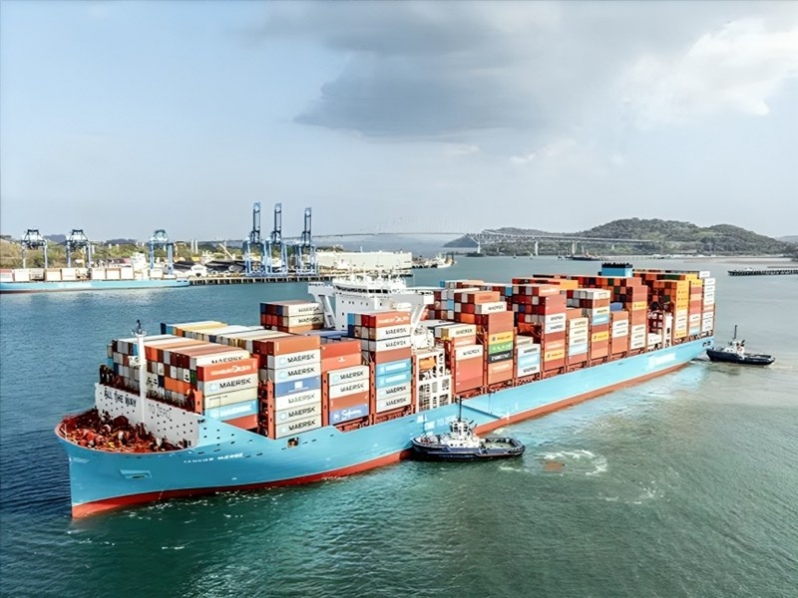
The need for diversification and resilience in supply chains strengthens the ties between the two regions
Global supply chains are undergoing a transformation driven by companies’ need to increase their resilience, flexibility, and diversification in the face of disruptions, shifts in demand, and geopolitical uncertainty. Against this backdrop, Asia and Latin America are becoming increasingly important as hubs for production, consumption, and investment.
This is the view of Thiago Covre, Maersk’s Head of Ocean, Latin America, who notes that for decades, supply chains were designed primarily around efficiency, with concentrated production and predictable trade routes. However, this model is changing. “What we’re seeing isn’t simply growth in trade volumes, but a broader reconfiguration of global supply chains,” says Covre.
According to the executive, Asia maintains its position as the world's leading manufacturing hub, while Latin America continues to expand its share of global supply chains. In particular, Mexico is consolidating its position as hub in manufacturing and distribution, while the markets on the West Coast of South America are gaining strategic importance as a link between producers, consumers, and international markets.
According to Covre, this trend is also changing companies' priorities. Customers are diversifying their sourcing strategies, expanding their manufacturing capabilities, and seeking stronger links between Asian production centers and Latin American markets.
The Strategic Role of Connectivity
In this context, connectivity takes on a strategic role. “Connectivity becomes more than just a logistical advantage: it becomes a strategic enabler of growth,” he says.
The executive points out that companies need to efficiently connect manufacturing, sourcing, distribution, and end markets as they grapple with increasingly fragmented and dynamic supply chains. The quality and reliability of those connections, he adds, are increasingly determining a company’s ability to capitalize on opportunities and manage risks.
As part of this evolution, Maersk recently introduced the "AC1" service‘, a weekly maritime service connecting ports in Asia and the West Coast of Latin America. According to Covre, the service aims to strengthen direct connections between the two regions, improve the reliability and predictability of the routes, support customers who are adapting their supply strategies, and reduce the complexity of their supply chains.
The executive also mentions the recently announced service ‘"West Coast Shuttle"’, a network of three ships that will connect Mexico, Panama, and Ecuador, expanding coverage and providing faster and more reliable connections between manufacturing, transshipment, and consumer markets.
These initiatives, Covre notes, are part of an effort to strengthen regional networks and create more integrated and resilient supply chains along the Asia–Latin America route.
Looking ahead, Covre anticipates that global trade will continue to evolve, with more diversified supply chains and greater demands from customers, while uncertainty will remain a significant factor in the operating environment.
In this context, he argues that Latin America is poised to play an increasingly important role in global trade, supported by the growth of its manufacturing capabilities, its geographic location, and the expansion of its consumer markets. “In today’s trade environment, connectivity is no longer just about moving cargo. It’s about enabling growth, building resilience, and opening up new opportunities,” he concludes.
Comments
You must log in to leave a comment.
Comments are closed on this post.